
Largo neighborhood · 33770
Tree Service in Harbor Bluffs, Largo, FL
Harbor Bluffs holds the oldest and most valuable single-family homes among our Largo neighborhoods, on lots along Clearwater Harbor. Salt wind, mangrove shorelines and narrow side yards decide how we work here, and county rules decide what needs a permit.
Jurisdiction: Unincorporated Pinellas County · Median year built: 1964
Check your address →Harbor Bluffs at a Glance
- Land and water area
- 0.693 sq mi of land, 0.26 sq mi of water
- 2020 Census population
- 2,646
- Single-family detached
- 99% (1,190 of 1,202 housing units)
- Median year built
- 1964
- Median home value
- $673,100 (ACS 2020–2024)
- Owner-occupied households
- 1,051 of 1,128
- Earliest aerial photo labeled Harbor Bluffs
- August 1958, USF Graber collection
- Helene peak at the Clearwater Beach gauge
- 6.67 ft above high tide, a record
Landmarks & streets
- Clearwater HarborThe Intracoastal water along the community's west edge.
- McGough Nature ParkNext door at 11901 146th St. N; boardwalks lead through mangroves, and there's a birds-of-prey area.
- Harbor Bluff DriveA residential street inside the Harbor Bluffs CDP, per Census address checks.
- Harbor View LaneAnother street the Census geocoder places inside Harbor Bluffs.
- Belleair CausewayThe bridge to the barrier islands, a short drive north in Belleair Bluffs.
Harbor Bluffs Tree Service, From the Seawall to the Street
Harbor Bluffs is a Census-designated place rather than a town. It covers 0.693 square miles of land and 0.26 of water on the Intracoastal side west of Largo, south of Belleair Bluffs, with water making up more than a quarter of its total area. A University of South Florida aerial photo from August 1958 already carries the name. Half its homes were built by 1964, the earliest median of our Largo neighborhood pages, and 1,190 of its 1,202 homes are single-family detached houses.
Because it's unincorporated, county code applies here, not the City of Largo's, even though the mail says Largo. Lots this close to salt water have three different tree zones, and we price and plan each one differently. For everything outside the harbor, see our tree service in Largo page.
The shoreline: mangroves and buttonwoods
Pinellas County protects mangroves and buttonwoods of every size. Mangrove trimming falls under state law and the county's delegated program: nothing cut lower than 6 feet, a registered professional trimmer for any mangrove taller than 10 feet, a permitted-trimming season of March 1 to November 30, and no removal or defoliation ever. Our crew doesn't trim or remove mangroves. We'll go over the rules, share the county's registered-trimmer list, and handle the land trees behind the seawall.
The pool deck and the palms over it
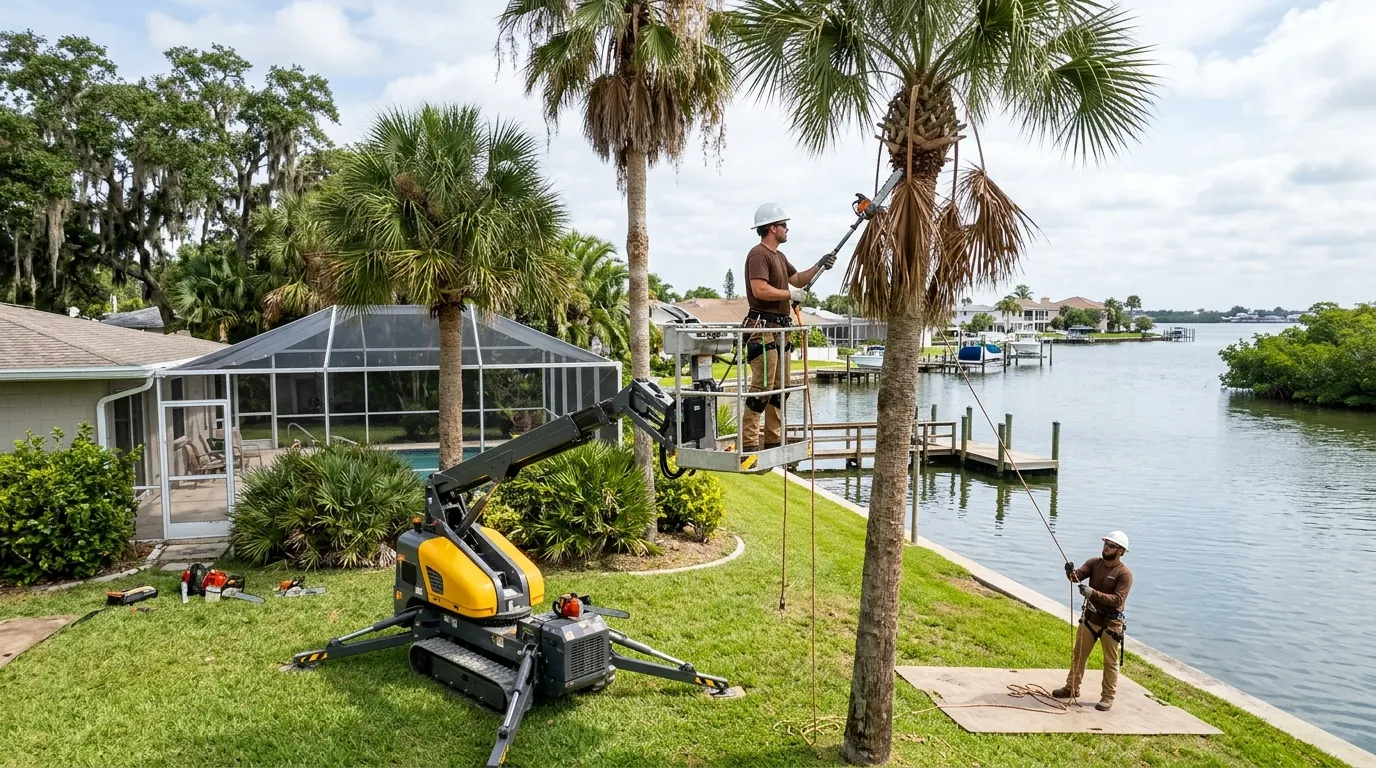
Waterfront back yards here usually mean a pool cage, a dock and a few tall palms. Sabal palms handle salt and wind better than almost anything else that grows here. Washingtonia palms can top 70 feet, and both they and queen palms are on the state invasive council's Category II list. Only spent fronds and seed stalks come off and the green crown stays whole, without the “hurricane cut” look, since palms trimmed that way lost more crowns in past storms. No one stands on a pool cage or a roof; we rig or work from a lift. Our palm tree trimming and palm tree removal pages cover both jobs.
The front yard and the big shade trees
Sea grapes often fill the gaps along waterfront fences and seawalls. Florida law makes it unlawful to cut or destroy sea grapes on public land, or on private land without the owner’s consent, so on your own lot, with your say-so, they can be pruned for a view or a walkway. Sea grapes on public shoreline are off-limits. Our post on sea grape and dune rules in Pinellas covers the beach side of that law.
Front yards carry the oldest trees on the lot, many planted 60 years ago, now spreading over roofs and driveways. Live oaks resist salt and wind well, so we usually prune them to keep them. Laurel oaks are shorter-lived and often hollow with age, so they get a closer look before anyone talks about saving them.
Tree Removal in Harbor Bluffs Under County Rules
Since January 23, 2026, the county asks a homesteaded, owner-occupied single-family detached home for a removal permit only when a trunk measures more than 24 inches. With 1,051 of 1,128 households here owner-occupied, that likely covers many Harbor Bluffs lots. It doesn't cover rentals, vacant lots or redevelopment sites. If an older house is coming down for a rebuild, protection begins at 4 inches, palms about 6 feet and up count, and replanting can apply.
Dead and dying trees rate Grade 0 under the county code: a permit, but no replanting. Pruning that follows ANSI A300 is exempt from the permit entirely. Detached single-family homes also have the Florida Statute 163.045 route: once an ISA-certified arborist or a Florida landscape architect finds unacceptable risk during an on-site assessment, local permits stop applying, though never to mangroves. We help set up that assessment but don't sign it ourselves.
Salt, Surge and Wind on the Harbor
At the Clearwater Beach gauge, Helene's water peaked at a record 6.67 feet over high tide, and coastal Pinellas generally saw 4 to 7 feet. Zone A was ordered to evacuate. We found no report describing flooding inside Harbor Bluffs itself, so we won't claim any. Milton followed two weeks later with 80–100 mph gusts over much of the county and left 73 percent of Duke's Pinellas customers without power.
Salt affects trees two ways. Spray on leaves mostly rinses off with rain. Salt water standing around roots kills most plants, and the salt concentrates as soil dries. UF/IFAS suggests holding off on removing a leafless tree until fresh leaves have had time to show, and a palm can go six months or longer without a new frond. A browned tree isn't automatically a dead one, and we'd rather check twice than remove a tree that would have recovered.
Access, Cranes and Power Lines on Waterfront Lots
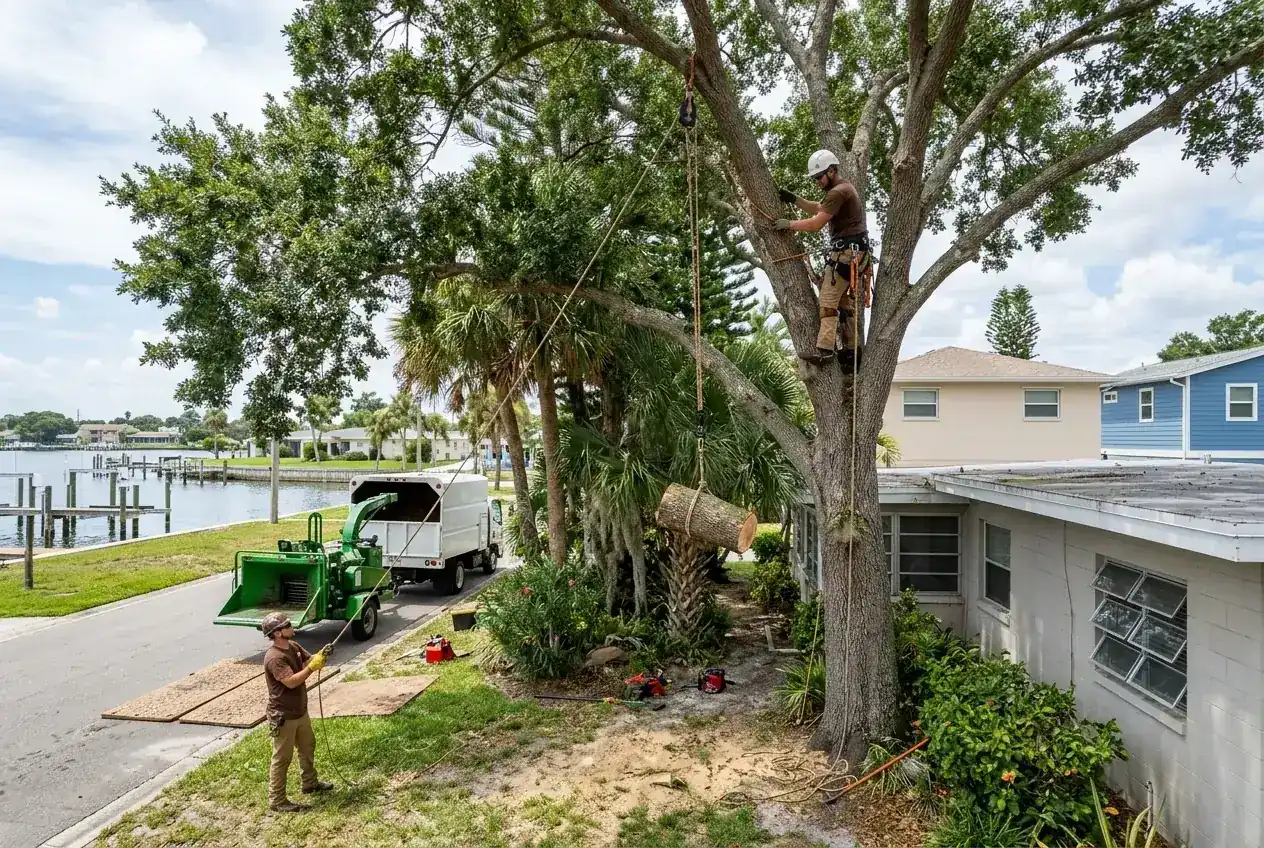
Waterfront houses often sit close together with narrow side yards, fences, pool equipment and a seawall at the back, which leaves little room to land a limb. Most removals here are climbed and lowered in sections, then carried out to the street. For a big tree with no safe way to lower it, the answer becomes crane work when the job needs one, set up from the street with the lift planned before the truck arrives. Any tree touching a line is Duke Energy's first; our crew stays away from energized primary lines, and Duke will also cut power to your service drop for free on request.
Harbor Bluffs Tree Service Costs
Here are the typical Largo-area ranges for 2026 that come up most on the harbor. Read them as estimates; quotes come after a visit. Trimming a palm 25–45 feet tall usually costs $200–$450, and tall Washingtonias over 45 feet run $350–$800 each. Trimming a shade tree 35–55 feet tall is typically $575–$1,250. Removing a tree with a trunk over 36 inches starts from $2,800 with a written quote, and a crane adds $900–$2,800 to a job. Lots where every piece is hand-carried to the street carry a 25–45 percent tight-access surcharge. We don't price mangrove work because we don't do it. Our guide to tree removal costs in Largo explains each factor.
Cleanup and haul-off are included; in unincorporated Pinellas, owners otherwise hire their own hauler. Next door, Belleair Bluffs uses the same county permits, and Walsingham and Oakhurst follow them inland.
Harbor Bluffs Tree Service Questions
Harbor Bluffs questions, answered.
No. It's an unincorporated Census-designated place with a Largo mailing address, so Pinellas County's tree code applies, not the city's.
No, we don't trim or remove mangroves. The county limits trimming to no lower than 6 feet, requires a registered professional for mangroves over 10 feet, and allows permitted trimming from March 1 through November 30. We'll explain the rules and point you to the county's registered-trimmer list.
Not automatically. Salt spray often rinses off, and a palm's next new frond can be six months or more away. Extension specialists recommend giving a defoliated tree time to regrow first, and we check the bud before recommending removal.
No. The 24-inch exemption covers a homesteaded single-family home its owner lives in. Redevelopment sites, rentals and vacant lots fall under the standard 4-inch threshold, palms about 6 feet and up included.
If the house is your homesteaded single-family home, the county regulates only trunks above 24 inches. On other unincorporated properties, palms around 6 feet tall and up are protected. Your parcel gets checked before any cut.
Tree Services in Harbor Bluffs
The rest of the crew’s work.
Get a Written Price for Your Harbor Bluffs Trees
Tree work in Harbor Bluffs? We’ll check the rules and price it.
- Hours
- Mon–Sat 7am–6pm
Storm calls taken - Every price
- Free, on site, written before work
- Every job
- Cleanup and haul-off included
Free written estimate
Describe the tree and the street it’s on. Someone from the crew reads each request and calls or texts back Mon–Sat.
Request received
Got it. Someone on the crew will read your note and get back to you Mon–Sat 7am–6pm. Tree down on a roof or carport right now? Call (727) 624-0396.
A picture of the tree speeds up the price: send it by text.