
Nearby Pinellas town · 33772, 33776
Tree Service in Seminole, FL
Seminole grew out of an 1879 homestead and 1920s citrus groves, and the city has earned Tree City USA recognition each year since 2001. Its tree code is stricter about oaks and pruning than most of mid-Pinellas, and looser about palms. We trim and remove to that code, and we tell you up front when a job needs more than a permit.
ZIP: 33772, 33776 · Oak rule: Live and laurel oaks from 4 in.: arborist report with the permit
Check your address →Seminole at a Glance
- Population
- 19,364 (2020 Census); 18,997 (2025 estimate)
- Land area
- 5.188 sq mi
- Elevation
- 36 ft, per the city's Key Facts
- Single-family detached
- 41% of housing units (ACS 2020-2024)
- Median home value
- $348,500 (ACS 2020-2024)
- Tree City USA
- Every year since 2001
- Hurricane Milton rain
- 13.76 in. at Seminole 0.9S
- Seminole Fire District
- About 100,000 people over about 25 sq mi
Landmarks & streets
- Meares LakeThe lake on the land Albert and Dell Meares homesteaded with their ten children in 1879.
- Seminole United Methodist ChurchBegan as Marvin's Chapel in 1891; a 1921 hurricane destroyed it and it was rebuilt in 1924.
- Fred Marquis Pinellas TrailRuns on the railbed of the Tampa and Gulf Coast Railway, which reached Seminole in 1914.
- Bay Pines VAOpened in 1933 as a national home for disabled soldiers and became Bay Pines Veterans Hospital in 1934.
- Seminole ElementaryOpened in 1915; today 18 buildings on 10.2 acres.
- Former Oakhurst Water Tower siteThe tower went into service in 1959 and was taken down in 2017.
- Seminole CemeteryEstablished in 1894, the same year as the area's first school.
Seminole Tree Service on Old Homestead and Citrus Ground
The city's own timeline gives a quick read on Seminole's trees. In 1879 the Meares family homesteaded the land around what is now Meares Lake. In 1891 Marvin's Chapel went up, and a 1921 hurricane flattened it. The railroad arrived in 1914 on a line that is now the Pinellas Trail. The first citrus groves came in the 1920s and 1930s, and after the war the area shifted from farming to houses, a change that ran through the 1940s and 1950s. Most of today's homes followed later; the city's median house was built in 1979.
- Grove-era trees: a stray citrus or an old pine can still turn up at the back of a lot that was once farmland.
- Subdivision oaks: live and laurel oaks planted or spared as the subdivisions went in, many now taller than the houses.
- Planted palms: queen palms and Washingtonias added by later owners, plus native sabals.
- Low, wet edges: yards near ponds and drainage ditches, where roots tend to stay shallow.
Seminole has held Tree City USA status every year since 2001, keeps a resident Tree Advisory Committee, and its code reflects that attention. Two parts of that code drive most of our work here: what it says about pruning, and what it says about oaks.
Tree Trimming in Seminole: What the Pruning Rules Require
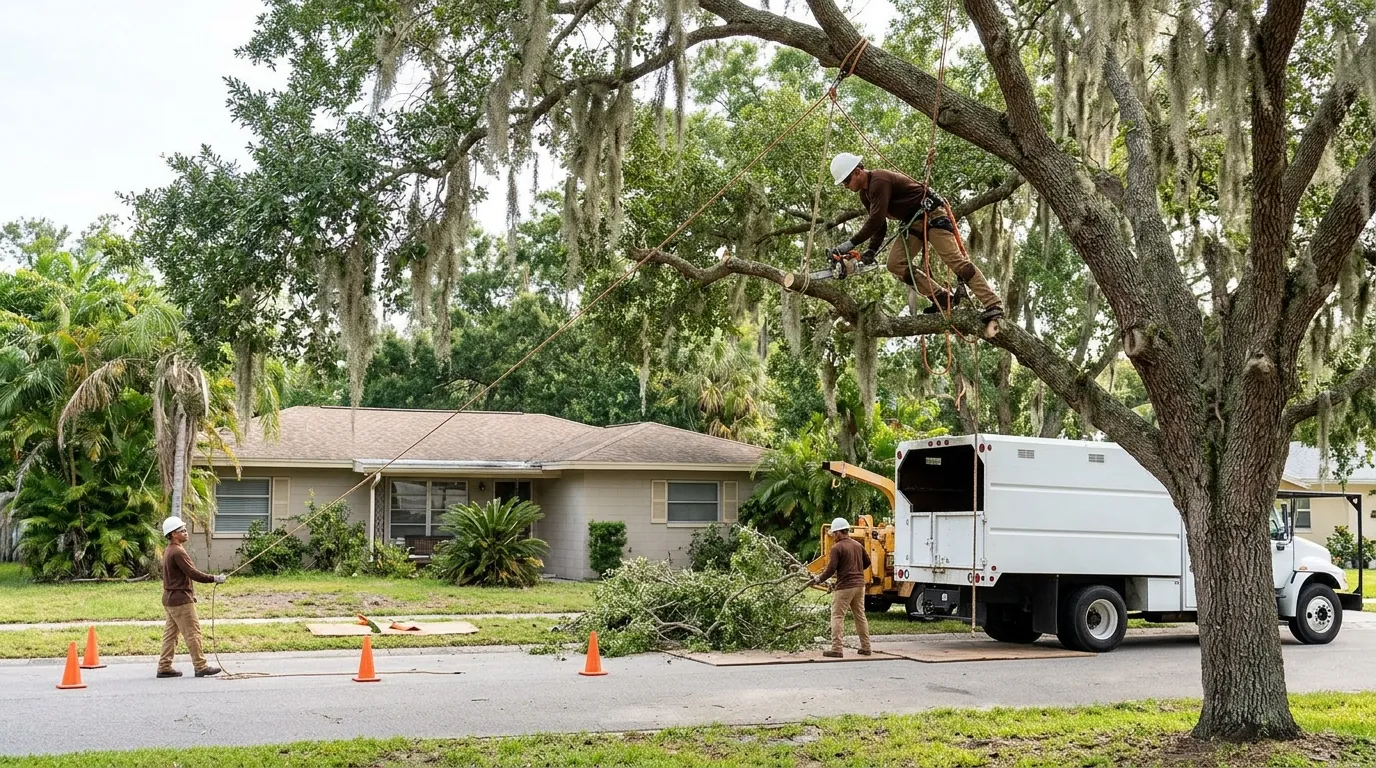
Seminole is one of the few nearby cities whose code speaks directly to how private trees are cut. Topping is banned on protected private trees, meaning trees of 4 inches or more that aren't on the exempt list. Pruning is to follow the ANSI A300 standard, and flush cuts and stub cuts are both prohibited. A flush cut slices off the branch collar the tree needs to seal the wound; a stub leaves dead wood sticking out to rot. Good cuts sit just outside the collar, and that's how our tree trimming crews make every one.
Over roads and sidewalks, the code wants 13 feet 6 inches of open space under the canopy. That's higher than the 8 feet over sidewalks Largo asks for, and it's sized for trucks, not pedestrians. A Seminole oak hanging low over the street is often both a code issue and the reason the garbage truck keeps clipping it. Lifting a canopy to that height is usually a matter of removing a few lower limbs with proper cuts, not cutting the tree back hard.
Seminole Oak Tree Removal and the Arborist Report
Live oaks, laurel oaks and mangroves are treated as protected specimens in Seminole from just 4 inches across the trunk. For those, and for pine, elm, red maple, sweetgum, sycamore, bald cypress and magnolia at 20 inches and up, the permit application has to carry a signed report from a certified arborist showing the tree is dead, dying, declining or damaging a structure with no reasonable way to save it. City staff don't write those reports. For a laurel oak, which UF/IFAS gives roughly 50 to 70 years of landscape life, that means even a clearly failing tree goes through the report step.
We don't write the report either; we're a tree crew. What we do is measure each tree, note species and condition, and help you get the right arborist out so the application doesn't sit waiting. The 2018 permit form lists a $25 fee, which we confirm is still current when the paperwork goes in. When the arborist finds a tree dead, diseased, declining or dangerous, the per-inch mitigation fee doesn't apply, though replacement trees can still be required.
When a Seminole address isn't the City of Seminole
Plenty of homes with a Seminole mailing address sit in unincorporated county land, and those follow the Pinellas County code instead: where an owner-occupied, homesteaded house is regulated only for trees past 24 inches. Inside the city, a posted notice and the written code also disagree about when homeowners need permits; the notice names seven subdivisions that always do, including Seminole Groves and The Cove at Bay Pines. So we never tell a Seminole owner a permit isn't needed until we've checked the parcel and asked the city.
Palm Trimming in Seminole Without a Permit Question
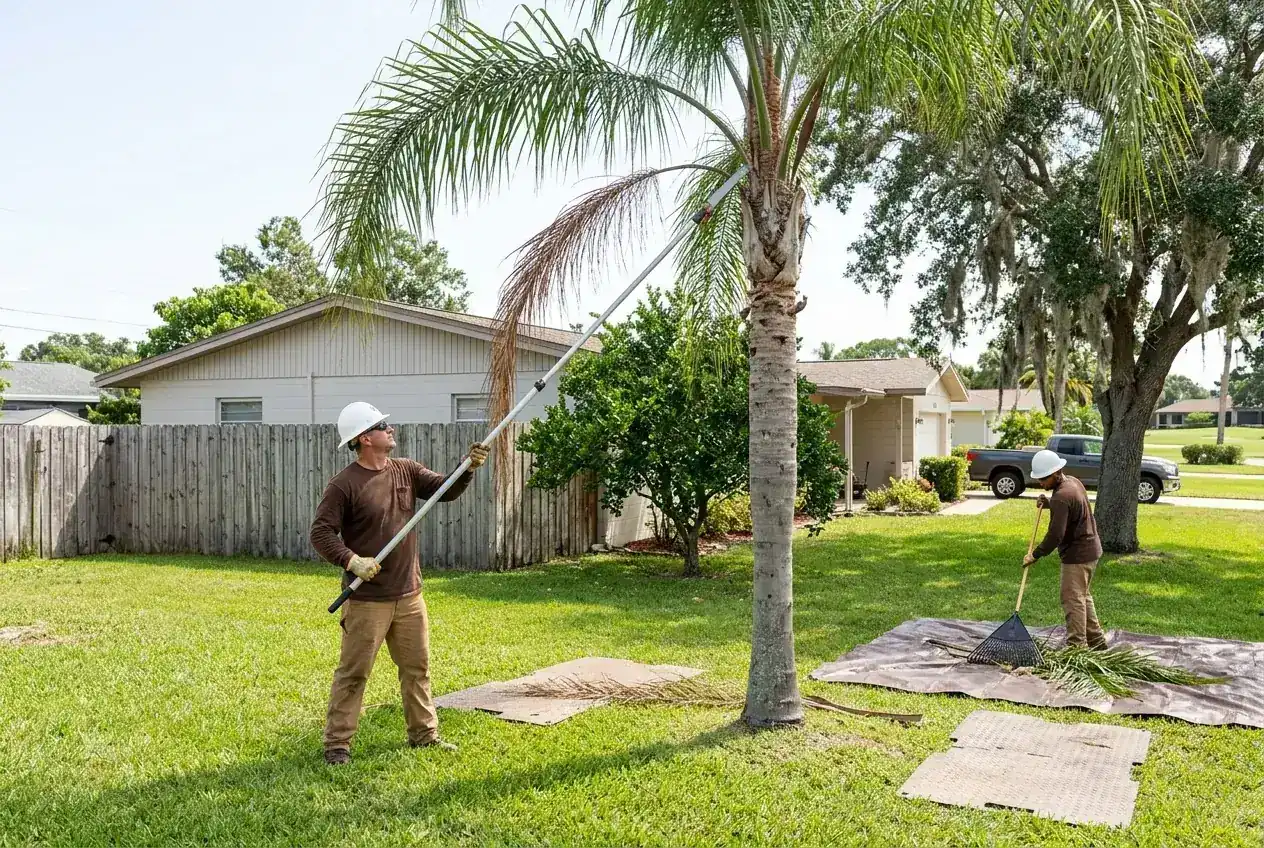
Here's where Seminole is easier than its neighbors. Palms aren't counted as trees under the city code, except on approved commercial landscape plans. A homeowner can have queen palms cleaned up or a tired Washingtonia taken down without a city tree permit. The exempt list also covers melaleuca, ear tree, chinaberry, jacaranda, camphor, Chinese tallow and the two invasives we clear most, Brazilian pepper and Australian pine, which our invasive tree removal crews handle. Good palm practice still applies: dead fronds only, no hurricane cuts, and a cleaned saw between palms.
Seminole Tree Removal Cost After a 13-Inch Rain
Milton left 13.76 inches of rain at a station just south of the city. That's the kind of soaking that loosens root plates under big oaks and pines, and it's why we look at lean and soil cracks before we price anything tall. Ballpark Largo-area figures, never quotes: an oak whose crown spans less than 30 feet costs $350 to $750 to thin and deadwood, trimming a 35 to 55 foot tree runs $575 to $1,250, taking down a tree 12 to 24 inches through the trunk costs $625 to $1,450, and a 12 to 25 foot palm is $110 to $275 to trim. The city's permit fee passes through at cost, and the arborist bills separately.
Waste Pro picks up Seminole yard waste twice a week in 4-foot, 50-pound bundles, but a full tree job is far beyond that, so we haul every piece. Seminole borders the county land of Walsingham and Oakhurst and Bardmoor, which is why the address check comes first. We're the same crew that does tree service in Largo. Our removal cost guide explains the price bands, and you can book a free estimate any day Monday through Saturday.
Seminole Tree Service Questions
Seminole questions, answered.
Generally not inside city limits. Seminole's code doesn't count palms as trees except on approved commercial landscape plans. If your Seminole address is actually in unincorporated county land, the county's rules apply instead, so we check the parcel first.
The city treats live oaks, laurel oaks and mangroves as protected specimens from 4 inches in trunk diameter, and its permit process asks for a signed certified arborist's report justifying removal. City staff don't provide that service, so we help you line one up.
No. The city bans topping of protected private trees and prohibits flush cuts and stub cuts, with pruning to follow the ANSI A300 standard. We use reduction and clearance cuts instead.
The city code requires the canopy to clear the street and sidewalk by 13 feet 6 inches. We lift the canopy to that line with a few well-placed cuts rather than cutting the whole tree back.
Not always, and the city's own documents disagree on the details. Some subdivisions always need one, and oaks need an arborist report. We confirm with the city for your address before any work starts.
In typical Largo-area ranges, oak thinning on a canopy under 30 feet wide runs $350 to $750, and removal on a 12 to 24 inch trunk falls between $625 and $1,450. We haul everything, and estimates cost nothing.
Tree Services in Seminole
The rest of the crew’s work.
Book a Free Seminole Tree Estimate
Tree work in Seminole? We’ll check the rules and price it.
- Hours
- Mon–Sat 7am–6pm
Storm calls taken - Every price
- Free, on site, written before work
- Every job
- Cleanup and haul-off included
Free written estimate
Describe the tree and the street it’s on. Someone from the crew reads each request and calls or texts back Mon–Sat.
Request received
Got it. Someone on the crew will read your note and get back to you Mon–Sat 7am–6pm. Tree down on a roof or carport right now? Call (727) 624-0396.
A picture of the tree speeds up the price: send it by text.