
Nearby Pinellas town · 33785
Tree & Palm Service in Indian Shores, FL
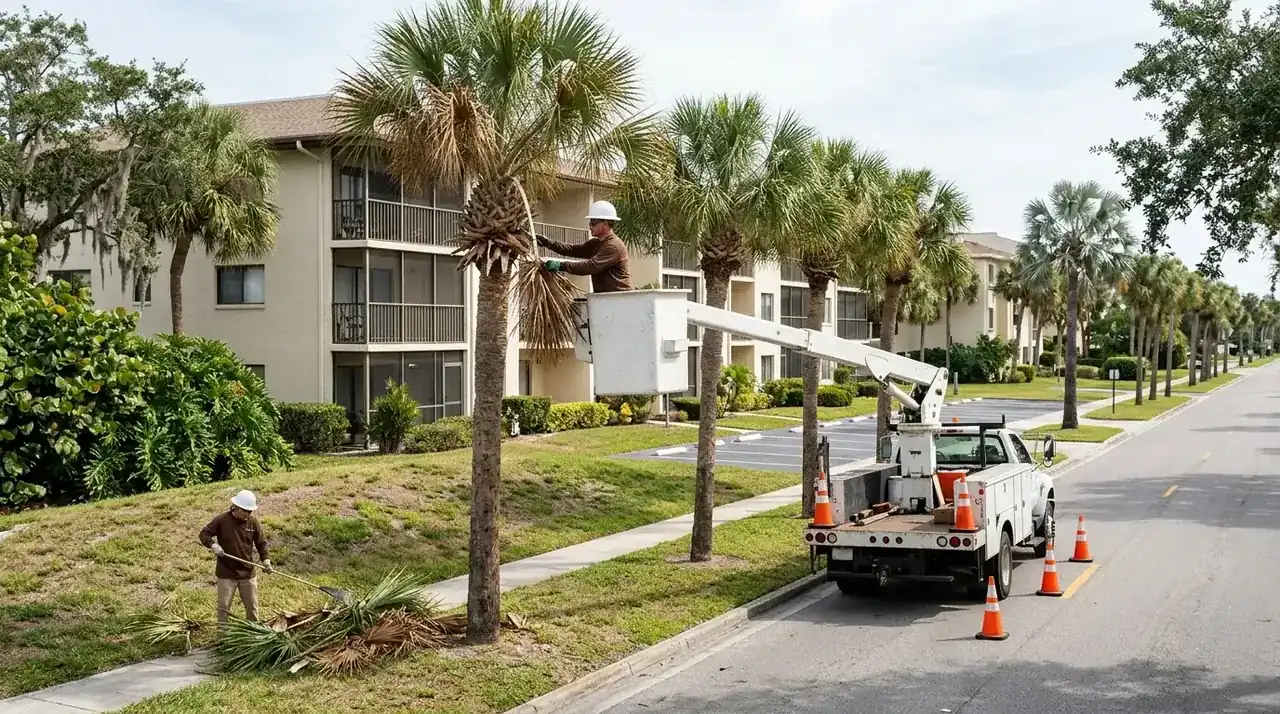
Indian Shores averages about a block wide, and most of its homes are condominium units in mid-rise and high-rise buildings. So most tree work here starts with a board, a property manager and a row of palms along Gulf Boulevard. We write scopes boards can vote on, follow the county code the town adopted, and haul every frond away.
ZIP: 33785 · Who hires us: Mostly condo boards and managers
Check your address →Indian Shores at a Glance
- Population
- 1,190 (2020 Census); 1,167 (2025 estimate)
- Land vs water
- 0.334 sq mi of land, 0.632 sq mi of water
- Incorporated
- Sept. 16, 1949, as Indian Rocks Beach South Shore
- Housing in 20+ unit buildings
- 1,474 of 2,568 units (ACS 2020-2024)
- Single-family detached
- 6% of housing units
- Median home value
- $698,800 (ACS 2020-2024)
- Vacant housing units
- 74.2% in the 2020 Census, mostly seasonal
Landmarks & streets
- Seaside Seabird SanctuaryOn the beach side of Gulf Blvd.; Helene left it covered in debris, but no birds were lost.
- Town Building Department19305 Gulf Blvd., where building permit questions start.
- The filled passThe government filled an old pass in 1927, joining upper Sand Key to the beaches to the south.
- Gulf BoulevardThe town's spine, with an FDOT landscape project of coontie, firebush, Fakahatchee grass and railroad vine.
- The former Tiki GardensA one-time roadside attraction now remembered in the Indian Rocks Historical Museum's exhibits.
Palm Tree Trimming in Indian Shores Starts With the Board
The town's own history describes Indian Shores as averaging only a block in width. It was incorporated on September 16, 1949, as Indian Rocks Beach South Shore, and took its present name in 1973. Today the Census counts 2,568 housing units, and 1,474 of them sit in buildings of 20 units or more. Only about 6% are single-family houses. In practice, the person calling us is most likely a property manager or a board member, and the trees are the palms and shade trees on the common grounds between the towers and Gulf Boulevard.
Association work runs on a different clock than a homeowner's job. Here is the order we follow for an Indian Shores condo, from first walk-through to the last truckload:
- Walk the grounds with the manager. Every palm and tree gets a number, a species, a height and a note on its condition.
- Check the rules for each tree. The town adopted the county tree ordinance, so removals on association property are reviewed against the county's protected list.
- Write one scope the board can vote on. Trimming, removals, stumps and hauling are priced line by line, so the board can approve part of it now and the rest later.
- Plan the work day around residents. Parking, pool hours and where the truck sits on a narrow lot are settled before we arrive.
- Leave nothing behind. Fronds, logs and grindings go out with us the same day.
Our HOA and condo tree work guide explains who usually approves and pays for common-area trees, and why association grounds don't get the homeowner exemptions that houses sometimes do.
Indian Shores Tree Removal Permits Under the County Code
Indian Shores doesn't write its own tree permit; its land development rules adopt the Pinellas County ordinance by reference and send protected trees to a county permit. Under that code, trees from 4 inches in trunk diameter, palms from roughly 6 feet tall, and all mangroves and buttonwoods are protected. Since January 2026 the county limits protection on homesteaded single-family homes to trees over 24 inches, but how that applies inside Indian Shores hasn't been confirmed, and with so few houses in town it rarely matters. Condo grounds don't qualify for it anyway. Dead and invasive trees go through the county's no-replant path, and the county commission sets permit fees, which we check for each job.
The county doesn't require a permit for routine pruning that meets ANSI A300. What the county treats as removal is topping, stripping a tree of its leaves or cutting too much root, and that applies to a condo's palms and shade trees as much as anyone's.
Gulf Boulevard Palms After Helene
Helene's surge crossed the island in September 2024. Indian Shores had no gauge, but sensors north and south of town recorded close to 7 feet of surge, 6.75 at Clearwater Beach and 7.26 at Madeira Beach. The Seaside Seabird Sanctuary on the beach side of Gulf Boulevard was left covered in debris with enclosures to rebuild, though, as the St. Pete Catalyst reported, no birds were lost.
For association grounds the storm left two kinds of tree problems. The obvious one was debris and broken palms. The slower one is salt in the soil, which UF/IFAS says builds up as flooded ground dries and can keep killing plants for months. Palms may take six months or longer to put out new fronds, so a board deciding which palms to replace should look for new growth at the heart before writing one off. When a palm is finished, our palm tree removal crew takes it down in pieces and grinds the stump so a replacement can go in.
Choosing replacements that can take the salt
The town's own Gulf Boulevard project shows what holds up here: FDOT's plan for the median and roadside uses coontie, firebush, dwarf Fakahatchee grass, railroad vine, a sea-tolerant juniper and crinum lily. For trees on condo grounds, sabal palms are the natural pick, since they handle salt and wind better than nearly anything else we work with. Queen palms are a weaker choice; they're on the state invasive list and prone to frizzletop, a manganese deficiency. The town's Florida-Friendly Landscaping page links UF/IFAS salt-tolerant plant lists for boards that want more options.
Working on an island one block wide
Before a wooden turn bridge opened in 1916, the town's history says, a ferry carried people across to the beach, and the old pass at the south end wasn't filled until 1927. The island is still narrow, and that shapes every job. Towers sit close to Gulf Boulevard, lawns between buildings are tight, and the truck often has to share space with residents' cars and delivery vans. We position the lift at the estimate, cone off the work zone and keep the ground crew outside it while fronds come down. For a tall palm with no room for a lift, a climber does the work, and for a big tree hanging over a building, a crane when nothing else will reach. If any frond or limb is near a power line, we stop and call Duke Energy before going further.
Storm Debris Cleanup in Indian Shores Near Mangroves
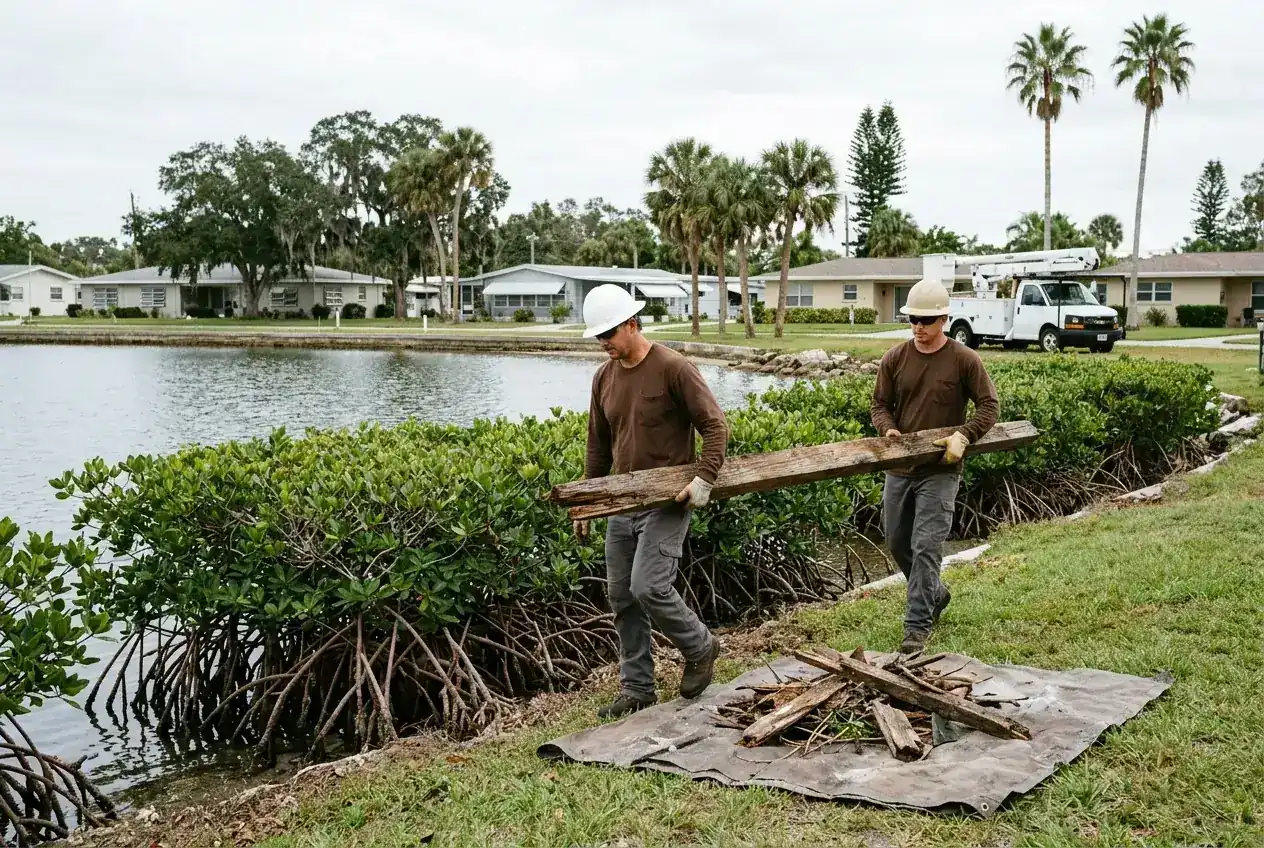
The town's storm page puts debris on private property, and that includes association property, on the owner. It also asks owners to clear storm debris caught in mangroves, while reminding them that trimming the mangroves themselves is regulated by the state. That's a line we hold: we pull lumber, fronds and trash out of a mangrove edge by hand, and we don't cut the mangroves. Over 10 feet tall, the county wants a registered professional doing the cutting, and permitted trimming only runs March 1 to November 30. Our storm damage cleanup service covers the rest.
Indian Shores Palm Service Cost
Here are typical Largo-area ranges for association work, estimates rather than quotes: trimming a palm 25 to 45 feet tall runs $200 to $450 a palm, removing a palm under 12 feet costs $150 to $375, and storm debris cleanup is billed by the crew-hour, $165 to $240, two hours minimum. When a board approves several stumps on the same visit, each one after the first comes off its price band by 40% to 50%. Hauling is always included. We work the whole island from the yard behind our tree service in Largo, including Indian Rocks Beach to the north and the Redington towns to the south. Request a written estimate for your association and we'll set up a walk-through with your manager.
Indian Shores Palm and Tree Questions
Indian Shores questions, answered.
No. The town adopted the Pinellas County tree ordinance by reference, so protected trees on its list need a county permit. We check each tree on the scope against the county list before the board votes.
No. The county's 24-inch threshold applies only to homesteaded single-family homes the owner lives in. Association grounds are reviewed under the regular rules, which start at 4 inches of trunk and roughly 6 feet of palm height.
We hand-clear debris caught in a mangrove edge, which the town asks owners to do, but we never cut or remove the mangroves themselves. Trimming them is regulated, and above 10 feet county rules call for a registered professional trimmer.
Sabal palms are the usual choice for salt and wind on the island. Queen palms are on the state invasive list and struggle near the beach. The town's Florida-Friendly Landscaping page links UF/IFAS salt-tolerant plant lists.
Yes. Our written scope prices each palm and tree separately, so the board can approve trimming now and removals or stumps at a later meeting.
In typical Largo-area ranges, a palm 25 to 45 feet tall runs $200 to $450 to trim. Hauling is included, and the scope and estimate are free.
Tree Services in Indian Shores
The rest of the crew’s work.
Get a Written Scope for Your Indian Shores Association
Tree work in Indian Shores? We’ll check the rules and price it.
- Hours
- Mon–Sat 7am–6pm
Storm calls taken - Every price
- Free, on site, written before work
- Every job
- Cleanup and haul-off included
Free written estimate
Describe the tree and the street it’s on. Someone from the crew reads each request and calls or texts back Mon–Sat.
Request received
Got it. Someone on the crew will read your note and get back to you Mon–Sat 7am–6pm. Tree down on a roof or carport right now? Call (727) 624-0396.
A picture of the tree speeds up the price: send it by text.